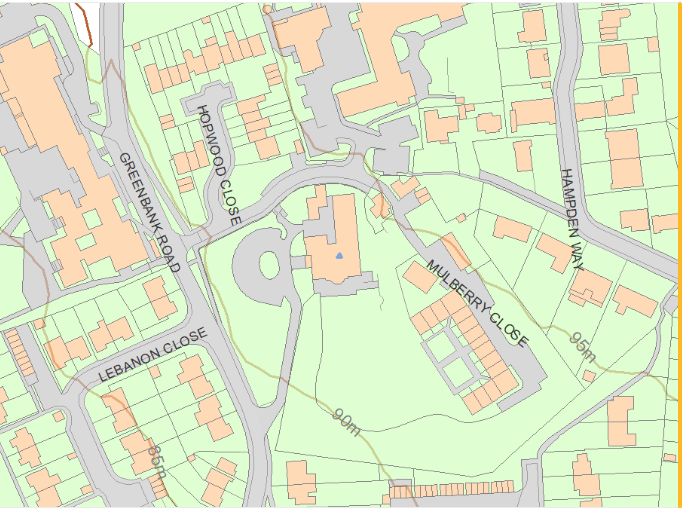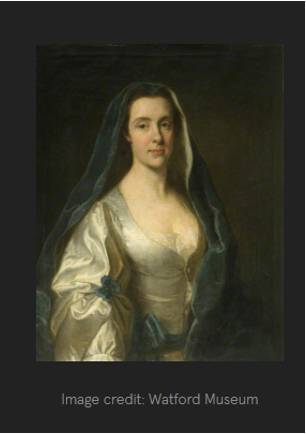
An early reference to the mansion appears in the Universal British Directory 1The Universal British Directory of Trade (1790’s) www.google.co.uk/books/edition/The_Universal_British_Directory_of_Trade/4QwHAAAAQAAJ?hl=en&gbpv=1&dq=Universal+Countess+Dowager+of+Essex+Russel&pg=PA703&printsec=frontcover compiled between 1793 and 1798 which recorded:-

“Russel [sic] Farm, built by the Right Honourable the Countess Dowager of Essex, mother of the present earl, and is now occupied by the Right Honourable the Ladies Capel, sisters to the said earl.”
The “said earl” was William Anne Holles, the 4th Earl, who succeeded to the title in 1743 aged 10, and died in 1799. In 1753 he reached the age of 21 and the terms of his father’s will required his mother to move from Cassiobury House. He married a year later, and in that period it was common for the dowager and sisters to be expected to move to a dower house when the son married.
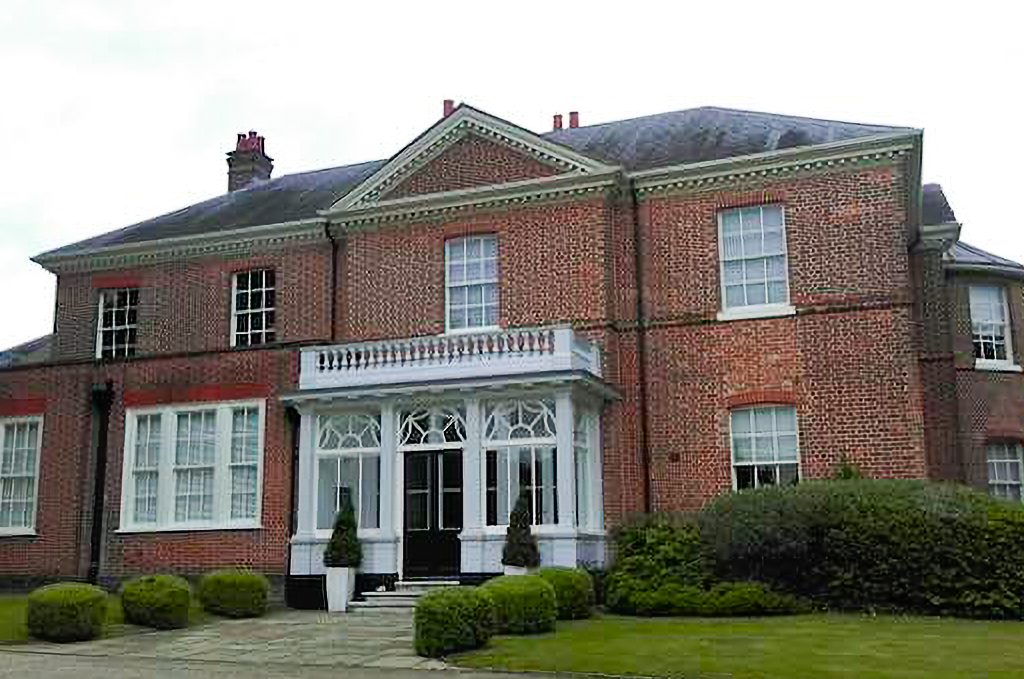
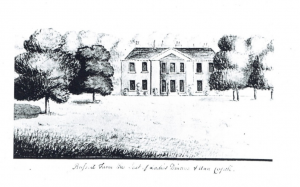
With this in mind Elizabeth, the Dowager Countess of Essex, formerly Lady Elizabeth Russell and daughter of the 2nd Duke of Bedford, purchased the Estate, still known as Tooleys Farm, from her son and commissioned Thomas Wright to design a dower house to which she and her two unmarried daughters, Lady Diana and Lady Anne Capell could move.
Wright’s natural talent and abilities led him to excel in a wide variety of fields including astronomy, mathematics, and scientific instrument making as well as garden design and architecture. The mansion was built to his design in 1753 by Stiff Leadbetter, one of the leading builders of English country houses of the mid eighteenth century. Further details of the house are provided here.
(In older English texts, the letter that looks like an “f” is actually a form of the lowercase “s” called the “long s” or “medial s”, not the letter “f”)
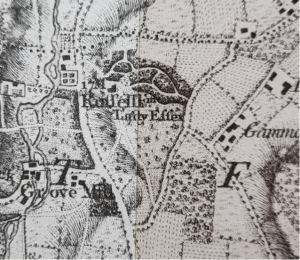
It appears that the dowager located her house carefully as a document dated 1795 includes the comment
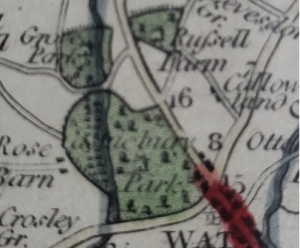
“The taſte of the late Dowager Counteſs of Eſſex was always applauded,
for her contrivance of overlooking (from Ruſſel farm) the grounds of neighbouring ſeats, very manifeſtly not belonging to herſelf.”
The new house was sited opposite two of the local grand houses, Grove Park and Cassiobury Park
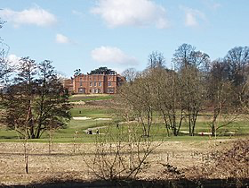
The Grove was the bought by Thomas Villiers in 1753. Villiers later became 1st Earl of Clarendon. He married Charlotte Capell in 1752, the step daughter of Elizabeth Capel (Russell). It was built about 1720 as a country house and served as the seat of the Earls of Clarendon, the Villiers family, from 1776–c.1920.
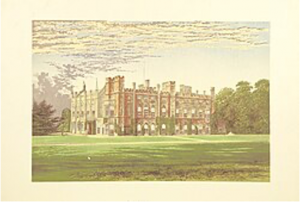
Meanwhile, Elizabeth’s son William Anne Holles, Earl of Essex, and his family lived at Cassiobury House. This was the ancestral seat of the Earls of Essex, dating from 1546. (It was demolished in 1927, and part of the land surrounding it is now a public park.)
Dowager Countess of Essex, Lady Diana and Lady Ann Capel
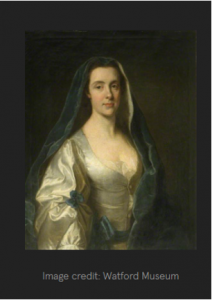
Elizabeth Russell was born in September 1704 in London, the daughter of Wriothesley Russell, 2nd Duke of Bedford and Elizabeth Howland.
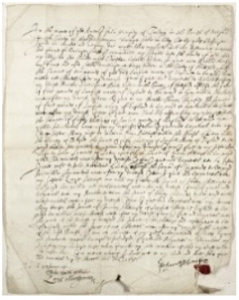
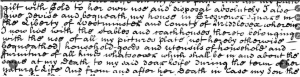
She married William Capel, the 3rd Earl of Essex in 1726, and died on 8 June 1784. When she died she left the Estate and her other property jointly to her two single daughters Lady Diana and Lady Anne.
“……..all my Estate formerly called Tooleys and now Russell Farm which I purchased of my son the Right Honorable the Earl of Essex……”
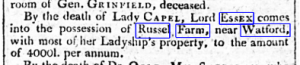
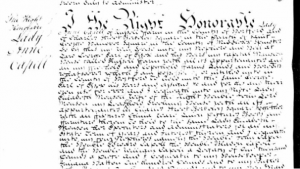 Other household servants were each to receive a year’s wages while Sarah Arthur, a child living with her and “educating as a servant maid“, was given £20 a year for life. The Annual Register recorded that Anne had died at her house in Berkeley Square. She was “in her 74th year……sister to the late and aunt to the present earl of Essex, who comes into possession of Russell farm, near Watford, with most of her ladyship’s property, to the amount of £4000 per annum.”
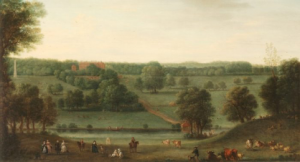 A View of Cassiobury Park (1748), John Wootton. Credit Watford Museum’s Cassiobury Collection
The people in the painting are: Lady Clarendon, Mary Forbes, Dr Johnson, Bishop of Worcester, Eliz Countess of Essex, Wm. Earl of Essex, Lady Caroline Egerton, Sister to the Duke of Bridgwater, Duke of Bridgwater, Lady Anne Capel, Lady Diana Capel (A Black Servant and a Keeper).
Grosvenor Square, London
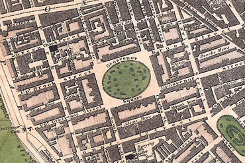
According to British History Online in Survey of London: Volume 40, the Grosvenor Estate in Mayfair, Part 2 (The Buildings)’, the house was Number 7 Grosvenor Square, and was occupied by the 3rd Earl of Essex 1740–1, his wife and (from 1743) widow, 1742–54 and their son, 4th Earl, 1755–61. At the time of its demolition in 1955 this was still basically the house built by John Simmons in c. 1727 as one of the two terminal blocks of the Square’s symmetrical east side.
Note. In 1761–3 work was done for the seventh Earl of Northampton, and a year or two later Stiff Leadbetter, the designer/architect of Russell Farm House in 1754, did some repairs.
Note. 3rd Earl of Essex occupied number 33 from 1737–9.