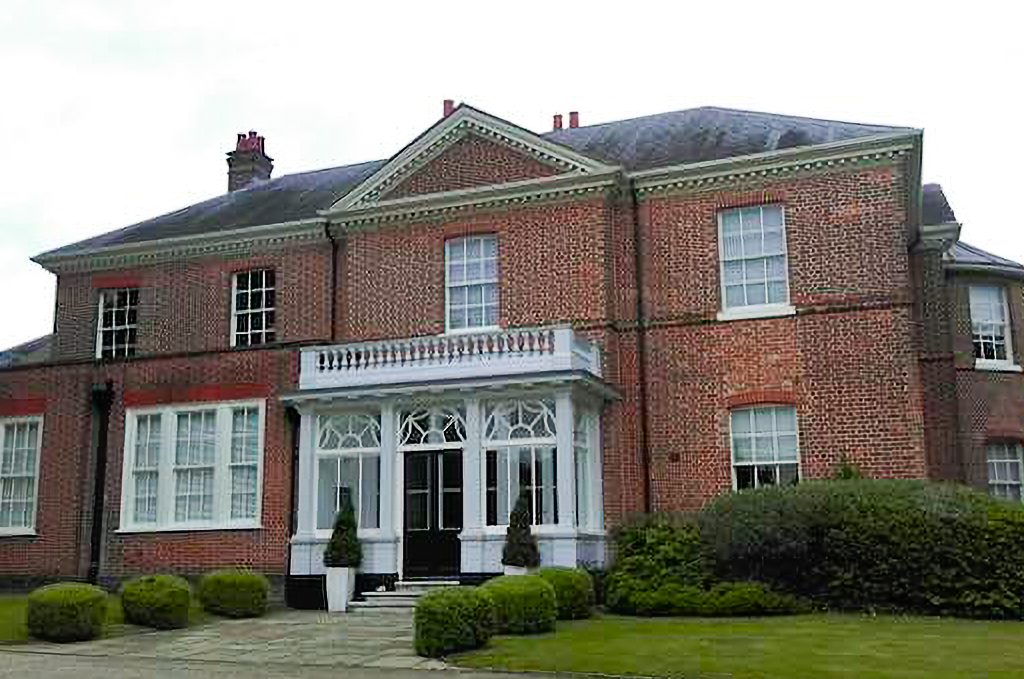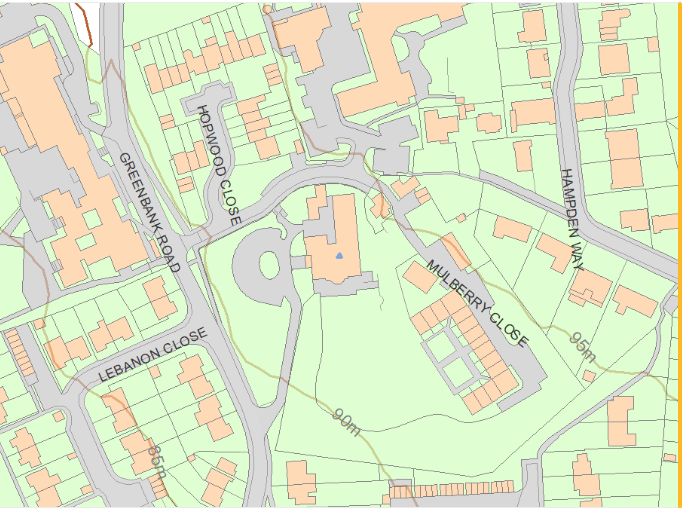
For almost a century following Lady Anne Capell’s death in 1804 the Earls of Essex let the mansion and the Estate to a succession of tenants. They are described in the following paragraphs. It should be added that there may have been others who have left as yet undiscovered evidence of their stay. To those who could afford it, the mansion was an attractive residence, set in the countryside yet within easy reach of the capital, especially after the coming of the railway in 1837.
Note – The dates shown against the various residents in this section reflect a confirmed residence date such as a census or a document reference – the exact periods are not always known.
It is likely that these tenants also had London residences and from newspaper cuttings there was a lot of coming and going.


The Regency Period
According to Wikipedia “the Regency era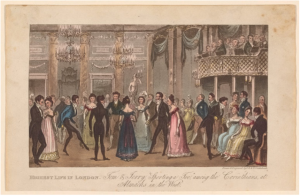 of British history is commonly understood as the years between c. 1795 and 1837, although the official regency for which it is named only spanned the years 1811 to 1820. King George III first suffered debilitating illness in the late 1780s, and relapsed into his final mental illness in 1810. By the Regency Act 1811, his eldest son George, Prince of Wales was appointed Prince Regent to discharge royal functions. When George III died in 1820, the Prince Regent succeeded him as George IV. In terms of periodisation, the longer timespan is roughly the final third of the Georgian era (1714–1837), encompassing the last 25 years or so of George III’s reign, including the official Regency, and the complete reigns of both George IV and his brother and successor William IV. It ends with the accession of Queen Victoria in June 1837 and is followed by the Victorian era (1837–1901)”.
1805 General Alexander Ross
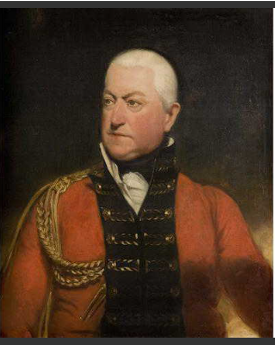
The first of the Earl of Essex’s tenants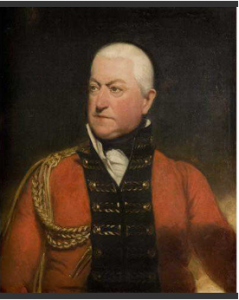 was General Alexander Ross (1742-1827) who, in taking out an insurance policy in September 1805, gave his address as Russell Farm near Watford. Ross was a British army officer who served in the American War of Independence and later in India. In 1795 he had married Isabella Barbara Evelyn Gunning.
In 1806 the Oracle and Daily Advertiser, London said that “General Ross intends giving an elegant Dinner this day at his beautiful farm near Watford.”
In 1807 the Oracle and Daily Advertiser, London said that “General Ross arrived yesterday at his house in Grosevenor –street, from Russell Farm, Watford, Herts.”
1813 Lord Henley
In 1813 there is mention of a Lord Henley at Russell Farm.
1Pinnock’s History and Topography of England and Wales. [With Maps.]1825 Pinnock, William
Lord Henley was probably Morton Eden, 1st Baron Henley. In 1799, Eden was created Baron Henley, after having been knighted in 1791 and admitted to the Privy Council in 1794. On 7 August 1783, he had married Lady Elizabeth Henley (the youngest daughter of the 1st Earl of Northington) and they had four children. Lord Henley died in 1830 and was succeeded by his eldest surviving son, Robert. Confusingly he is buried in Watford, Northants
1813 Robert Myddleton Biddulph
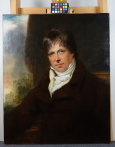
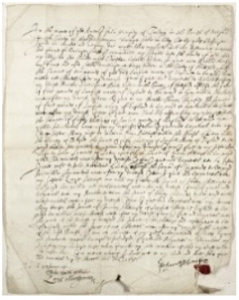
In October 1813 Robert Myddleton Biddulph (1761-1814) leased the mansion and Estate, totaling an estimated 119 acres, from the Earl of Essex for seven years at a yearly rent of £400. Interestingly the lease mentioned that the Estate had lately been in the occupation of Lord Henley.
Robert Biddulph had made his fortune, estimated to be worth £70,000 a year, in the service of the East India Company and as a partner in the London bank of Cocks, Biddulph and Company. When he married Charlotte Myddleton, a co-heiress of the Chirk Castle estate in Denbighshire, in 1801 he took the name of Myddleton.
His enjoyment of Russell Farm was brief. In August 1814 he made a short will leaving everything to his wife and died very soon afterwards. There were though still Myddleton Biddulphs at the mansion until the lease expired.
As evidence of this in late 1820 or early 1821 The Society for the Encouragement of Arts, Commerce and Manufactures awarded a large silver medal to Miss Myddleton Biddulph of Russell Farm for a portrait in chalk.
1822 Sabine Robarts
In 1822 the 16th edition of a well-known road atlas of the time, Paterson’s Roads, was published. Showing the principal roads of England, Wales and parts of Scotland, it also gave brief descriptions of towns and cities and named the wealthier inhabitants. Watford, it noted, was a “neat town, consisting principally of one street rising with a gentle ascent nearly 1m……..the manufacture of paper, and throwing of silk, form the chief employments”, while readers were informed that Russell Farm was occupied by Mrs Robarts (1752-1833). Born Sabine Tierney, she married Abraham Robarts in June 1774.
The Robarts family had been bankers since the founding of Robarts, Curtis and Company in 1791 and in 1796 Sabine’s husband became MP for Worcester, a seat he held until his death in November 1816. Sabine Robarts outlived her husband by almost seventeen years and died at Russell Farm in September 1833. In her will she made various specific bequests of items located at Russell Farm.

Whilst she lived at Russell Farm there was regular travel to their London home. On some occasions she was accompanied by Colonel Robarts, probably her son Colonel George James Robarts who died in 1829. For example, the Morning Post in 1824 referred to Colonel and Mrs. Robarts travelling to Russell Farm.
1835 Sir Charles Colville
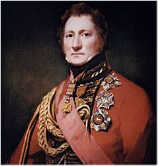 Colville (1770-1843) was a British army officer, commanding troops during the Napoleonic Wars and afterwards serving as commander-in-chief at Bombay and later as governor of Mauritius, a post he held from 1828 to 1834. Sabine Robarts died at Russell Farm in September 1833, so it is reasonable to assume that Colville may have moved in following his return from Mauritius. He was mentioned by John Britton in his book The History and Description with Graphic Illustrations of Cassiobury Park, Hertfordshire: The Seat of the Earl of Essex published in 1837.
Writing of Russells Britton noted:- “The lodge [now South Lodge, Hempstead Road] to the seat called Russell Farm has recently been erected on the roadside, between Watford and Berkhamstead. The seat is occupied by General Sir Charles Colville, Bart. under the Earl of Essex”
For much of the rest of the nineteenth century census records enable us to identify those residing at the mansion and the servants who lived and worked on the premises. The first census was in 1801 and has been held every ten years ever since, with the exception of 1941. The earliest census records simply give us the number of people living in an area. More usefully that of 1841 is the first to name individuals.
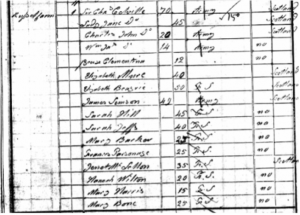
The 1841 census shows Sir Charles Colville in residence at Russell Farm with his wife, Jane, two sons and sixteen servants.
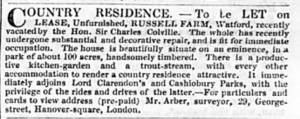
The house was advertised in 1842 as recently vacated by Hon. Sir Charles Colville.
1844 Charles John Pearse
According to the St Mary’s Watford records Pearse was living at Russell Farm by 1846 when his daughter Florence was baptized, and probably by 1844 when another daughter was baptized in Watford.
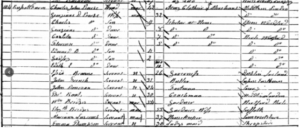
Charles Pearse was still at Russells at the time of the 1851 census. At 42 years old, he and his 32 year old wife, Georgiane, had seven children all under the age of ten. To complete the household there were sixteen staff living in.
Pearse is still living there in 1856, as the Gardener’s Chronicle says
“ Mr Munro gr to C Pearce Esq of Russell Farm Watford also furnished some good table Apples which were however not different from those just named In collections of Apples for kitchen use”.
Note- a George Munro was listed in the 1851 census as a gardener at The Grove.
The connections to the next Russell House residents may have been formed years earlier. In 1841 Charles John Pearse had a contract/bond to supply white list cloth and sureties were provided by a Henry Pearse and A W Robarts. A.W. Robarts was the late husband of Sabine Robarts, resident in 1822. In addition one of Pearse’s sons was named Godfrey/Henry Robarts Pearse.
In the 1860 London Royal Blue Book, Pearse is listed as living at both 35 Bryanston Square and Russell Farm.
Note: In 1868 daughter Georgiana, who was living at Russell Farm in 1851, married a Francis Austen, who seems to be distantly related to Jane Austen, the novelist.
John Horncastle
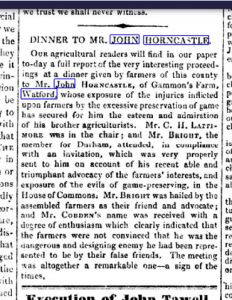
In 1844, Gammons Farm had 238 acres of land, most of which was arable, with 20 acres being meadow.5 Lying between Gammons Farm and Leggatts Farm was a strip of 55 acres of woodland, with more nearby. The owner at that time was the 6th Earl of Essex, and the occupier was John Horncastle. John Horncastle became something of a hero amongst tenant farmers when he managed to get compensation from the Earl of Essex for damage done to 40 acres of corn and clover by the Earl’s preserved ground game. A dinner was held in his honour n 1845 in St Albans, attended by John Bright MP, one of the leaders of the Anti-Corn Law movement, who also campaigned for the rights of tenant farmers.
1861 Abraham John Robarts
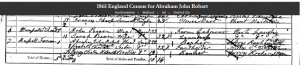
An unexpectedly youthful head of the household at the mansion listed in the 1861 census was 22 year old unmarried banker Abraham John Robarts (1838-1926), who may have moved to Russells after the death of his father in September 1860. Living with him were his five younger siblings with ten servants to run the mansion. Robarts was the great grandson of Sabine Robarts mentioned in 1822, and this connection may have drawn him to the property.
Whether Abraham Robarts rented the mansion directly from the Earl of Essex, or whether it was being sublet to him by Charles Pearse is unclear, but Pearse certainly retained some interest in the Estate. In February 1862 the Herts Guardian announced the auction over two days, at Russell Farm, of furniture and live and dead stock on the instructions of “Charles Pearse, Esq., who has left the neighbourhood”.
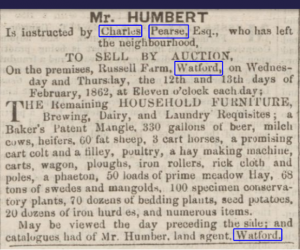
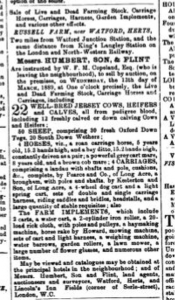
This advert gives an insight into the farming of the time, mid 19th Century.
1862 William Taylor Copeland
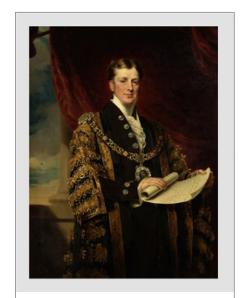
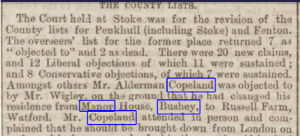
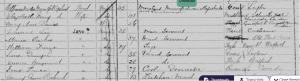
Shortly afterwards the Robarts family too had left and from 1862 William Taylor Copeland (1797-1868) was in residence until his death there in April 1868. (His previous residence was Manor House, Bushey.)
Copeland is often mentioned in articles about Russell House, as one of the more well-known occupants

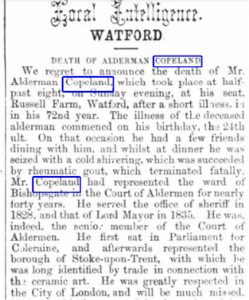 Earlier Copeland had a wide ranging career. The only son of William Copeland, partner of Josiah Spode the china manufacturer, the younger William succeeded his father as head of the porcelain firm in London, eventually buying out the interests of the Spode family in London and the Potteries. He was married to Sarah Yates. As a politician he was Lord Mayor of London and a Member of Parliament. In 1866 Copeland was appointed china and glass manufacturer to the Prince of Wales while his other business interests included directorships of three railway companies.
Copeland’s industrial and political life has been well documented.
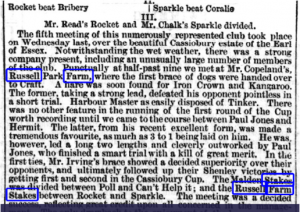
Note: It is believed that Goodwood Recreation Grounds in Watford, England, were originally fields used by William Copeland to stable his racehorses and let them run. (Copeland commissioned painter John Frederick Herring Sr. to paint his racehorses – but probably not whilst Copeland was living at Russell Farm.)
1869 William Fowler Mountford Copeland
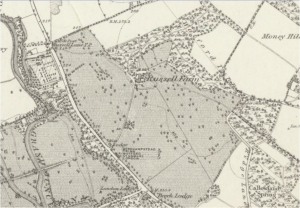
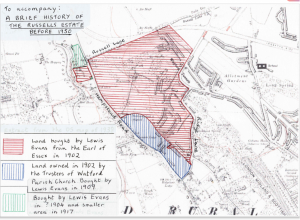
Note: Additional information on maps showing the state is provided in the Maps section
Middle Classes in the mid 19th Century
“The middle-classes of the mid-nineteenth century were an extremely heterogeneous body embracing at one end bankers and large industrialists with incomes from investment and profits of over £1,000 per year and at the other end small shopkeepers and clerks with annual earnings of under £50. The middle-classes can be divided into two broad groupings. The upper middle-class was divided into two fairly distinct groups: the financiers and merchants of London and the manufacturers of the North and Midlands. The former were generally wealthier, of higher social status and closer to the landed elites than the industrialists.”
George Turnbull Diary – Society Life
George Turnbull (1809-1889) did not live at Russell House but his diary contains many mentions of occupants. Turnbull was “the Chief Engineer responsible for construction of the first railway line from Calcutta: the 541-mile line to Benares en route to Delhi. He was acclaimed in the Indian Government’s Official Gazette as the “First railway engineer of India”.
In his autobiography he provides an interesting view of the social life of various Russell Farm occupants across the decades.
He mentions
“Letter from Mr. Hodgson, Vicar of Abbot.s Langley, mentioning Mr. Robarts’ death. He used to live at Cecil Lodge.”
This Mr Robarts is probably Henry Christopher Robarts who died in 1880 and who lived at Cecil Lodge – brother of A J Robarts at Russell Farm. H. C. Robarts lived at Cecil Lodge for at least a couple of years.
There are mentions of the Copelands in George Turnbull’s autobiography;
14th. With Fanny and Nelly to dinner, Copeland’s, Russell Farm. Sixteen in number, Rileys, Marnhams, Dr. Hood, Cohens, Lewis E., &c.
1889 Mr. and Mrs. W. Copeland came to say good-bye, they leave Russell Farm and are going to live at St. Leonard’s. Ball at Watford. F. took Evan Pole and the three girls
He also mentions the next tenant, Charles Jones who was his neighbour in London, in Cornwall Gardens.
1879 – 25th. At home sorting papers, books, etc., preparatory to leaving home on Tuesday next. Drove in the afternoon with Miss Blackburn and Fanny to Caldecote to see Mr. Charles Jones, our late neighbour, in Cornwall Gardens; pretty house, and a fine view to north-east.
1891 Charles Edward Jones
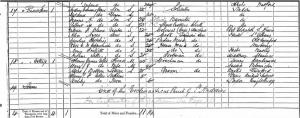
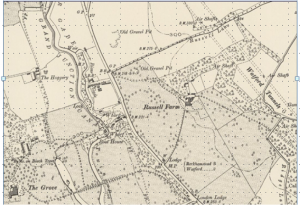
Note: Additional information on maps showing the state is provided in the Maps section
Note in a book from the 19th century
“If we leave the lodge gate again at Grove Park we shall find ourselves opposite Russell Farm, as it is called, though it is in reality a very fine residence, now occupied by a great China manufacturer. And here it may be well to point out that those who go by the present issue of Ordnance maps may be often misled, and it must rejoice pedestrians to think that a new issue may be expected in the fulness of time. Between Watford and Russell Farm is another farm bearing the name of ” Nascot,” and laid out apparently in a park.” 2Rambles round Eton and Harrow by RIMMER, ALFRED Page 226
As it turned out, the Jones family was to be the last of the Earl of Essex’s tenants

Note about his son – Francis Adolphus Jones
In August 1899 Francis Adolphus, son of Charles, married an Ada Charlotte Roberts of Watford. Francis became Sir Francis Adolphus Jones CB Legal Adviser, Ministry of Agriculture & Fisheries and Solicitor to Commissioners of Crown Lands in the 1925 Birthday Honours, (appointments by King George V to various orders and honours to reward and highlight good works by citizens of the British Empire).