The Original Building
The mansion was built to a design by Thomas Wright in 1753 by Stiff Leadbetter, one of the leading builders of English country houses of the mid eighteenth century.
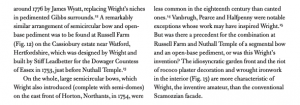
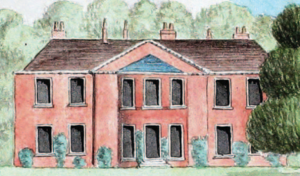
In an article in the Georgian Group Journal, “Jacobites and Horses at Nuthall Temple” Page 9 Eileen Harris describes the original building:
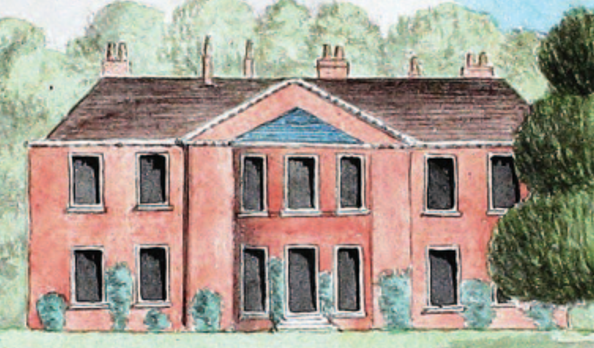
A watercolour painted by Oldfield c. 1875:
As it is now
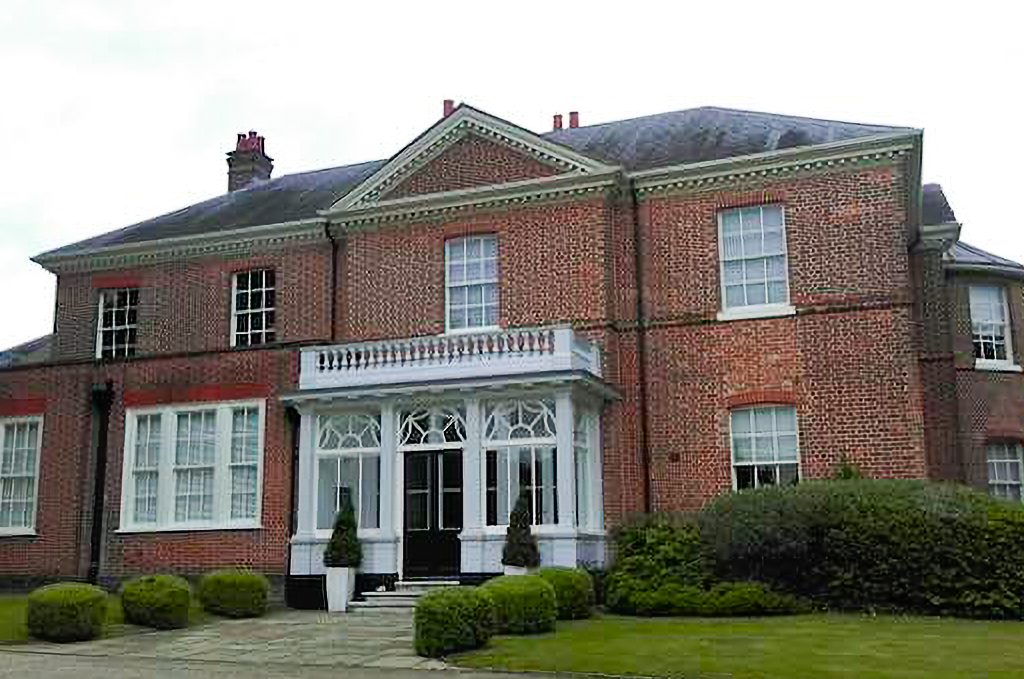
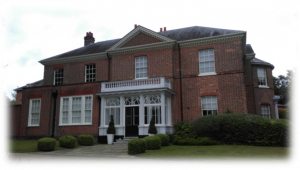 The listing for the property in Historic England describes the property as:
Later C18 red brick villa, altered in C19. Formerly part of Cassiobury estate. Two storey. Hipped low pitch slate roofs. Modillion eaves cornices. Entrance front originally 3 bay, extended to 4. Centre breaks forward with pediment. Sill band at 1st floor. Glazing bar sashes. Window heads slightly cambered. Circa 1900 projecting stone porch, glazed between piers on high plinth. Cornice and balustrade over. Projecting ground floor brick extension to left. South, garden front similar but with modern bargeboards to wide pedimental gable. Five bays. Projecting centre with big full height semi-circular 3 window bow, lead roof extending up into gable. Central stone Tuscan pedimented doorcase. Modern ground floor extension to left. C19 triple window to right. Long plain east front with later additions. North service wing, mostly C19 has a small cupola bellcote with vane dated 1718, possibly that removed from summer house of Watford House, demolished in 1904.
This building is listed under the Planning (Listed Buildings and Conservation Areas) Act 1990 as amended for its special architectural or historic interest.
March 1937
In March 1937 Russells (Watford) Estates Ltd granted a three year lease of the mansion and its grounds to Douglas Ian Otto Macaulay (1892-1972). Macaulay was a doctor of medicine who for some years had been medical superintendent at Chiswick House, Pinner, a nursing home for the treatment and care of mental illnesses, including alcohol and drug dependence, in both men and women. The next few months were spent in preparing the mansion for a similar role. In January 1938 an advertisement in The Lancet announced,
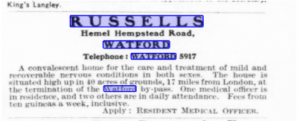 “This new convalescent home has just been opened for the treatment of mild and recoverable mental and nervous conditions in both sexes. The house is situated high up, in 40 acres of beautiful grounds, 17 miles from London. One Lady Doctor is in residence, and another specialist in psychological medicine is in daily attendance. Fees from ten guineas a week, inclusive.”
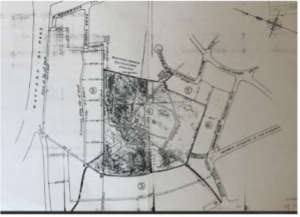
In January 1939 Macaulay bought the freehold of the mansion and 19 acres surrounding it from Russells (Watford) Estates Ltd. for £11,360-10s-0d (£11,360-50p). In September 1939 there were nine patients in residence and a larger number of staff. The inmates seemed to be people of means, two of the women being described as ladies of leisure!
1939
The 1939 Register/Census provides information on the occupants of the House
1946
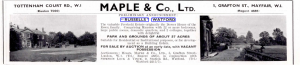 In 1946 the original Russell House was advertised for sale as “Russells’ Watford. “Comprising mansion with 22 or more bedrooms….”
1947
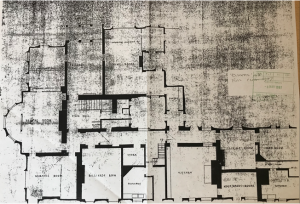
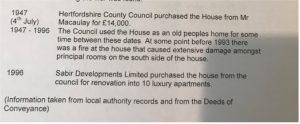
In 1947 Hertfordshire County Council purchased the house and surrounding land from Dr Macaulay for £14,000. They used the mansion as a residential home for the elderly and built housing for police officers nearby
1949
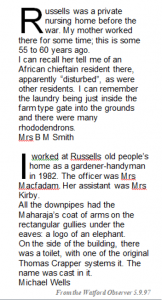
The residential home for the aged and infirm opened in Oct 1949, Russells was the first home provided by the County Council under part III of the National Assistance Act, 1948. The first residents were housed in Durrants, Croxley Green until Russells opened.
1950’s
Notes extracted from material held by Watford Museum – Watford Observer:
Houghton remembers Russell House in the 1950’s and tells me:
It was very well kept and had extensive gardens. In front of the house there was an orchard and at the back of it was trees, a bit of rough ground and a massive lawn.
In the end they allowed schoolchildren to use the lawn for tennis courts. There were four courts on one lawn. They took two days to mow it with a big mower, a-three-and-a-half horsepower Denis. They had two smaller lawns leading into the back entrance.
On the other side, there was a kitchen garden. That was two to three acres: it was vast. And then there was a wooded area on the other side that leads on to Leavesden Road. All I know is that there were some beautiful trees of all types in the grounds
1980’s
It later became an old people’s home until 1986 when it became vacant.
1988 Russell House Fire
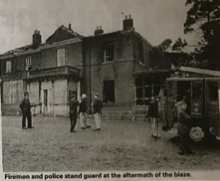
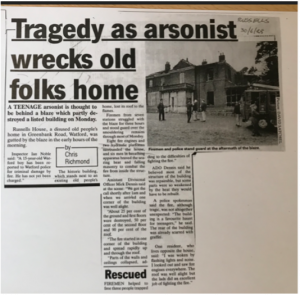
The 1988 fire at Russell House was a sad end to the old house and the start of its new life as apartments.
Daily Mail 2024 – “After the war, Russells House found a more genteel use as a retirement home – but then it lay derelict for a decade after being devastated by a fire. Happily, though, the potential of the Grade II-listed house was spotted by developers – and it was converted into elegant apartments.”
1990’s
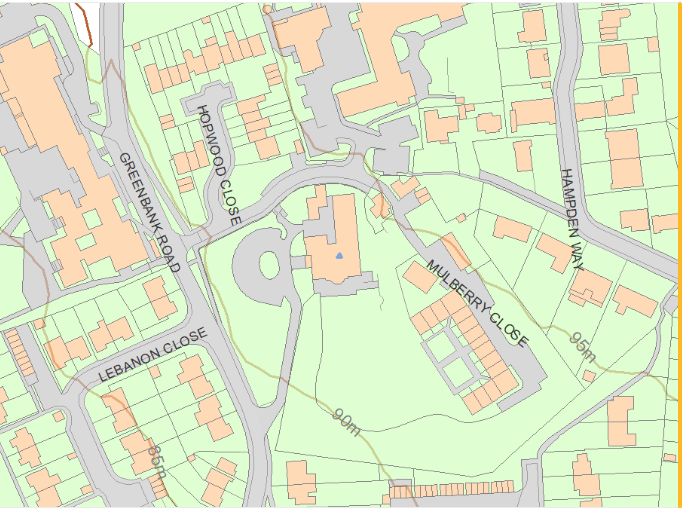
“During the 1990s, Russell House was converted into flats, while the 1950s care home was rebuilt and new housing was constructed along Hopwood Close and Mulberry Close. The bulk of the development consists of semi-detached housing of generic housing designs. Housing on Hampden Way is generally detached, while the 1990s development features a much wider range of building types.” (CoA, 2011)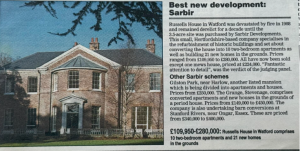
1996 Russell House Redevelopment
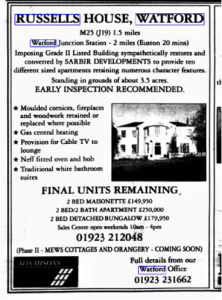
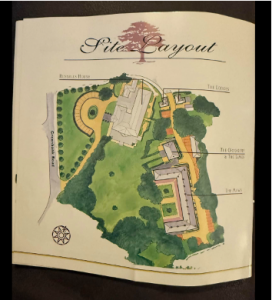 In 1996 the house and remaining 3.66 acres were sold to Sabir Developments Limited who converted the House into 10 luxury apartments and created new accommodation in matching developments named the Mews, The Orangery and Lodges.