History of the Gardens
Together with an overview of the design of parks and gardens there are a few mentions of Russells in the book by Hertfordshire Gardens Trust and Tom Williamson (Williamson, 2000). It says
“Note the contrast between Cassiobury – with avenues and formal rides through woodland and The Grove or Russells, with more regular and serpentine layouts”.1Page 45 Figure 34 Hertfordshire Gardens Trust and Tom Williamson (Williamson, 2000)
Perhaps the most notable reference relates to planning of the garden by Mawson in 1921 for the Maharajah of Baroda. T.H. Mawson was one of the “most important designers the early years of the 20th century”. Sadly it seems many of the planned improvements could not be carried out, due to prohibitive costs. In Hertfordshire Garden History Volume 2: Gardens Pleasant books by Deborah Spring, 2012,it is explained that Mawson produced a design for the gardens which was adopted, except for the proposed new drive and new greenhouses.
The Kitchen Gardens
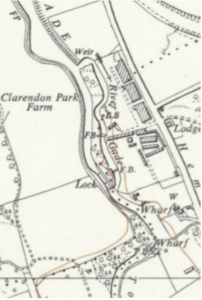
Russell Farm House kitchen gardens were located on the left hand side of Hempstead Road, near the river/canal.
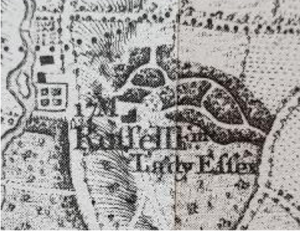
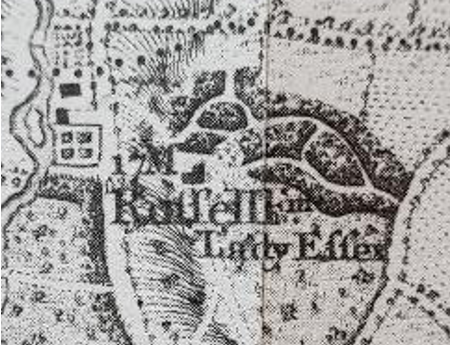
The 1766 Dury & Andrews Map shows Russell Farm House kitchen gardens as the square with four inner squares.
(In 18th-century English maps, walled gardens were often depicted with a symbol resembling a rectangle with a small, thick line or a fence-like pattern around the perimeter. This indicated that the area was enclosed and likely used for cultivating plants or fruits. The specific symbol could vary slightly depending on the cartographer and the map’s overall style, but the basic idea was to represent the enclosure.)
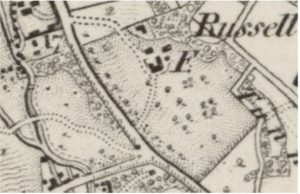
This map extract shows the gardens in early 19th Century – see top left corner.
 The house was advertised in 1842 in the Morning Herald (London) – it included mention of the kitchen garden and a trout stream.
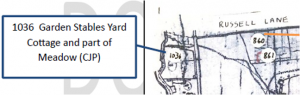
This map is an extract from the Tithe Map, dated 1842. 1036 was the area of the Kitchen Garden.
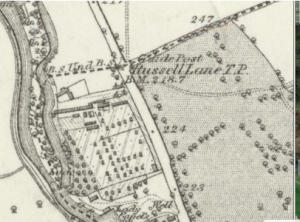
This map, published 1883, shows various buildings.
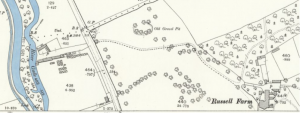
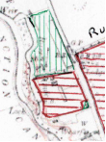 The kitchen gardens portion of land was still in the Russell Farm estate when Lewis Evans bought it from the Earl of Essex in 1902. Evans then added more land – shown in green.The particulars for the estate in 1902 said
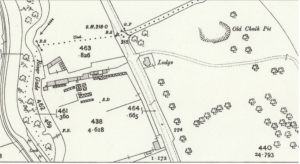
Then In 1920 Lewis Evans sold the nursery/gardens part, about 7 acres, to Thomas Rubithon Clark and Arthur Kingham, both of Watford, for £2,550.
It is likely there wa a ‘new’ kitchen garden area was added near the main house after 1920.
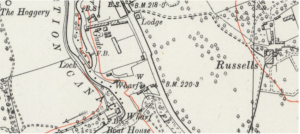
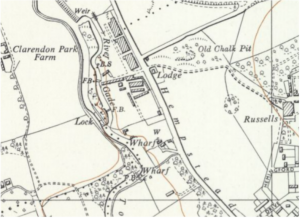
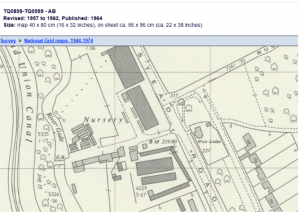 Published 1964
In the Watford Council document, Character of the Area, the general area was described as follows –
“various other structures were constructed for agricultural/horticultural activities – such as a nursery and piggery. In the later twentieth century the existing groups of buildings were joined by a number of larger footprint structures, including the complex of buildings at the Grove Pumping Station during the 1960s, the Church Of Jesus Christ Of Latter Day Saints in the 1980s and a garden centre development in the 1990s.
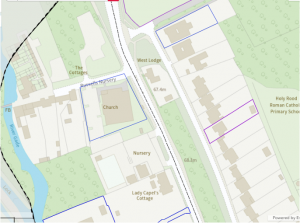
How it looks now:
Walled Garden
The original gardens were surrounded by thick walls typical of a country house of the time.
“The country house walled kitchen gardens2The genealogist.co.uk – article – gardeners-at-the-big-house-6426 varied in size from about one acre in the case of the aspiring merchant or professional owner, to twenty or thirty acres in the case of a leading aristocratic family. They were usually rectangular and divided into four quarters surrounded by brick walls as high as 12 feet. In some cases the walls were heated. The walls had a number of functions: they provided shelter, and they absorbed and transmitted heat. Fruits such as apples, pears and cherries were grown against the walls, with exotic fruits such as nectarines and peaches being grown under glass, netting, mats or canvas on the south-facing wall. Old walled kitchen garden walls are still often peppered with nails used for holding fruit against them. Inside or outside the walled garden, depending on its size, were glasshouses, including vineries for growing grapes and pineries for growing pineapples. Also outside the garden, usually built against the outside of the north wall, was the boiler house and a series of sheds including a potting shed, storage sheds and often the gardeners’ mess room.
Gardeners’ Bothy
The gardens also had a bothy. A garden bothy, historically, refers to basic accommodation, often for gardeners or other estate workers, usually found within or near walled gardens, and the term “bothy” itself comes from the Gaelic word “bothan” meaning hut or cabin.
The Gardeners Chronicle of 1906 rather grandly defines a bothy as “the apartments in a garden allotted for the residence of under gardeners”. These came in a variety of sizes. An advertisement from 1880 notes “two in bothy”. Bothy quality varied as well as the size. Frogmore, in 1903, had not only lavatories and dining room, but included a sick room and reading room. However at the other extreme one author in 1842 reported
 “The bothy is commonly a little lonely shed placed on the north side of the north wall of the kitchen-garden; that small apartment has often to be kitchen, breakfast-room, dining-room, parlour, bed-room, dressing-room, and study, for men that deserve better accommodation. If a little of the money that is spent upon dog-kennels were employed in erecting decent habitations for journeymen gardeners, gentlemen would receive a higher rate of interest for money laid out in such a way, than they do from much of their wealth that is sent out in other directions. ”
Garden Produce
19th-century walled gardens produced an array of produce including fruits, vegetables, and flowers. Fruits like peaches, nectarines, figs, grapes, and apples were grown, often against the sheltered walls of the garden. Vegetables like broccoli, melons, and pineapples were also common, with specialized frame-yards and glasshouses providing the necessary climate for tender plants. Flowers were also important, both for decoration and as a source of cut flowers, with bedding plants being a regular part of the garden’s output.
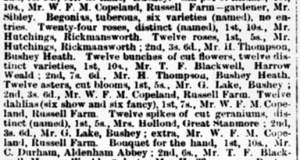
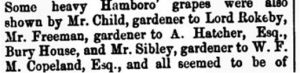
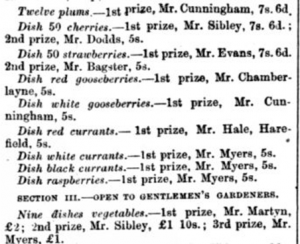
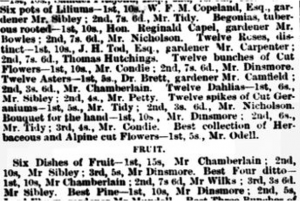
The range of plants, fruit and vegetables produced in the Russell Farm Gardens is demonstrated in the prizes awarded to William Sibley, gardener for the Copeland family living at Russell Farm in the second half of the 19th century.
The Gardener
Excerpt from The Victorian Kitchen Gardeners:
“The apprenticeship lasted for three years. Next, as a journeyman he would pass through the various stages of expertise, remaining no more than a year in any one situation. He moved from one eminent garden to another, possibly to a commercial nursery, a public botanic or municipal garden.”
The process, known as moving on, provided practical system of hands-on training and education in all horticultural techniques – but it makes it hard to establish who was working at the gardens
Charles Pearse is still living at Russell Farm in 1856 when the Gardener’s Chronicle says
“ Mr Munro gr to C Pearce Esq of Russell Farm Watford also furnished some good table Apples which were however not different from those just named In collections of Apples for kitchen use”.
A George Munro was listed in the 1851 census as a gardener at The Grove.
 William Sibley is mentioned in the 1871 census at Russell farm Yard as Farm Bailiff, but from the previous section he would also seem to be the gardener.

In 1891 George Curtis is listed at Russell Farm Gardens
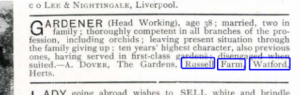 Alfred Dover was living with his family at The Gardens, Russell Farm in 1901. In 1902 he advertised for new situation, but according to the Electoral Register he was still living at Russell Farm in 1906. It appears he was retained when Russell Farm was sold to Lewis Evans in 1902. By 1911 he is living elsewhere in Watford, as a gardener. The advert in 1902 specifically mentions experience with orchids.
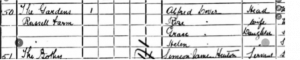 In this 1901 census Simeon James Hinton is living at The Bothy, next door, as a servant. He seems to have gone on to be a gardener.
 In the early 1900’s the Watford Electoral Registers show men living at Russells Bothy e.g. in 1912 – William Gristwood
A valued gardener might be remembered by his employer long after they had parted company. Having sold the Russell Farm Estate in 1920 and moved to Devon, Lewis Evans made his will in 1923. In this he recorded that he was paying his former gardener at Russells, Frederick Beck, a monthly pension of £3-10-0 (£3.50) and directed that this should continue for the rest of Beck’s life. Presumably Frederick Beck received this amount each month until he died aged 89 in 1939, having outlived his former master by over eight years.
 In 1911 Beck is mentioned in the census as living at Russell Farm.
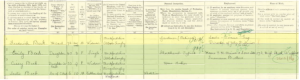
In 1921 he is living in Burton Avenue, Watford, a retired gardener and still recording he is employed by Evans.
Earlier in the 19th century William Sibley (1841 to 1920), mentioned in the previous section, was left an amount in the W. T. Copeland’s will. (Copeland was one the ‘famous’ Russell Farm House occupiers.)
After 1920
Sanders Nursery
The more recent history relates to the use of the land after it was sold in 1920 and when it was used by Sanders the famous Orchid Growers based in St Albans and Bruges.
Henry Frederick Conrad Sander (Heinrich Friedrich Conrad Sander (1847– 1920) was a German-born orchidologist and nurseryman who settled in St Albans, Hertfordshire, England and is noted for his monthly publication on orchids, Reichenbachia. Sander (later Sander and Sons) became the largest orchid establishment in Europe.
The nurseries at Bruges and Saint Albans continued in business for many years after Sander’s death but the family firm was voluntarily liquidated in 1958.
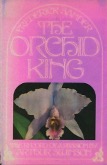 The Orchid King book by Arthur Horace Swinson and published in 1970 describes the Sander Orchid history.
 Roger Sander, a grandson, ran the Russell’ Nursery near The Grove in Watford, where, in addition to a range of flowering plants, he specialised in orchids.
There are various websites and articles addressing Henry Sander, colleagues, and family – but very little is documented about the Watford site.
Jack and Pearl Ruck
Jack and Pearl Ruck still live in the cottage they bought from Sanders about 75 years ago, when Jack started to work at Sanders Orchids. Jack’s father had worked for Sanders Orchids from 1930 in Bruges, and from 1939 in St Albans.
Jack lived in Bruges when his father worked there. He worked for Sanders Orchids St Albans in 1940, then Sanders Watford from 1942, before joining the RAF in 1943. When Jack left the RAF, he worked for Sanders Watford until 1950.
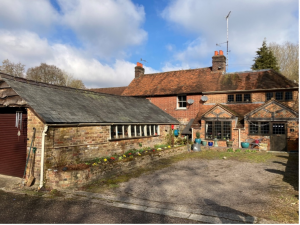
When Jack and Rose bought the Cottage (previously No 1.) it was very small and it has been extended a few times. The cottage, shed, greenhouse and garden still contain remnants of the original Russell Farm Estate nursery.
Extract from Watford Observer article in 2009-
“A young Jack Ruck and his family fled Belgium, where his father worked as an orchid merchant, in 1939 as the threat of German Nazism intensified. Upon his return, Jack joined the RAF and was posted to a base in Upper Hayford, in Buckinghamshire… On VJ Day, Jack was made redundant from his post in the RAF. But instead of following his father into the orchid trade, he instead trained to become a parachute instructor. Despite determined efforts to avoid going into the orchid trade, Jack eventually relented and took a job as an orchid grower for Sanders Orchids, on the promise the newly-weds could move into a house off Hempstead Road, in Watford. Almost 60 years on, the pair still live in the same house, in Russell’s Nursery, today, with each of their three children born in an upstairs bedroom.
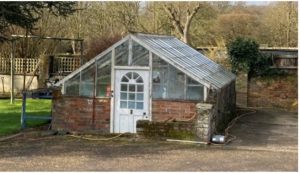
The greenhouse in Jack and Pearl’s garden is formed from part of one of the old larger greenhouses.
The old Kitchen Garden had a great big high brick wall around it – “to stop the rabbits getting in.” At the top of the wall there was a large water tank – as there was only a small pipe to garden, water had to be pumped into the tank. (Water supply was a key factor for the location of the garden – as there was limited supply by pipe.)
The nearby canal and wharf was important for the transport into London. (It took 3 days to travel from Birmingham to London by barge using horses.) Even after the railway was built it was cheaper to use the canal – with a husband and wife on the barge, and a horse pulling it.
“The original cottage was in the middle of the garden, and the footings are still there. There were three buildings. A little greenhouse then house, then another greenhouse.“
Jack’s deeds say his house was built in the late 1700’s. When they moved in 1947 it was a little tiny square house. The original outside wall went through the current lounge. When extending the house they found glass bottles in the wall/floor – this was a technique for insulation. The house was at the end of the old bothy. The bothy used to provide very basic accommodation for the 10 or so boys who worked in garden. Jack & Pearl’s cottage was where the garden lads had meals. The cart horses and carts were also housed in the buildings next door.
 The small greenhouse is the remains of the larger one that used to stand there. The remains of old foundations are still under the garden.
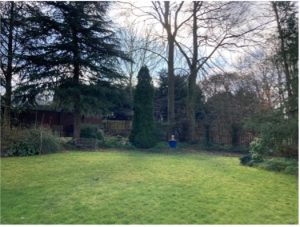
Note – The Sanders family wanted to grow cyclamen so Jack was sent for a year to learn about it at Waddington Manor. He realised that the soil was not suitable at Watford.
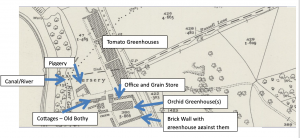
Sanders Orchids grew tomatoes in 3 large greenhouses north of lane, and orchids in the greenhouses south of his cottage. They bought the land because it was near the canal, with a water supply. Jack came to work for Sanders in 1947 when he left the forces. He was an engineer and his job was to keep the water at a suitable level in a tank via pumps, the mains supply being inadequate for the needs of the business.
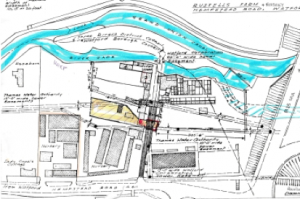
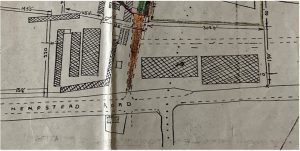
At some stage the old Kitchen Garden area was bought by Sanders Orchid growers and the next map shows the layout in 1939. The notations were provided by Jack Ruck.
Piggery and “Russell Farm
In the late 20th century one area of the old kitchen garden area was developed into a large-scale piggery owned by Ron Arnold with around 1000 pigs. The area and house is now known as Russell Farm.
Garden Centre
One part of the area became Clarks/Clarkes/Clarke’s nursery, and more recently the Plant Stop.
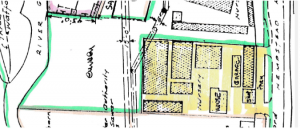 Extract from 1982 Plan showing Clarke’s nursery in yellow
Church of Jesus Christ of Latter-day Saints
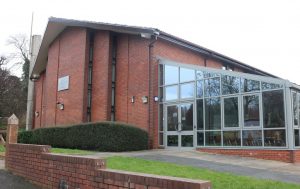
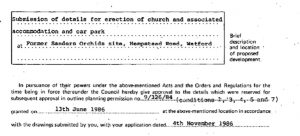 In 1986 planning permission was given to build “church and associated accommodation and car park on the former Sanders Orchids site”.
Canal and River
The location of the kitchen garden by the river was probably deliberate as the river would have provided a supply of water critical for the growing of the wide range of plants. Later the canal would have provided coal for the greenhouse heating. The river loop, parallel with the canal, also provided trout fishing for the Russell House occupants.
The canal, originally known as the Grand Junction Canal, was routed through The Grove’s grounds in the late 18th century after agreements were made with the Earls of Clarendon. The canal followed the course of the River Gade, which also flowed through the estate. The Grand Union Canal, a major transport route, connected Birmingham and London and played a significant role in the Industrial Revolution.
Our Watford History Page 15 provides this description:
“At the end of the eighteenth century, the roads of Watford were a bad state of repair. An alternative route had to be found for the transportation of heavy goods. Around 1793 the building of the Grand Junction Canal began in earnest, to connect London with the Midlands. Built by hand, it was fully open by 1805 and all the trade of the country began to travel along it. The speed limit was set at 4 mph.
Flowing through both Cassiobury and Grove estates, in 1819 the canal was eventually seen as a complement to the countryside. By 1860 a regular service of steam narrowboats ran both day and night. The journey from Watford to London took around a day and trade was varied, the biggest single item being carried was coal. Steady growth in London encouraged an important trade in house-building materials. “